Cameras and edge AI that watch each operation, verify every part and flag deviations in real time — turning standard operating procedures into something visible, measurable and traceable.
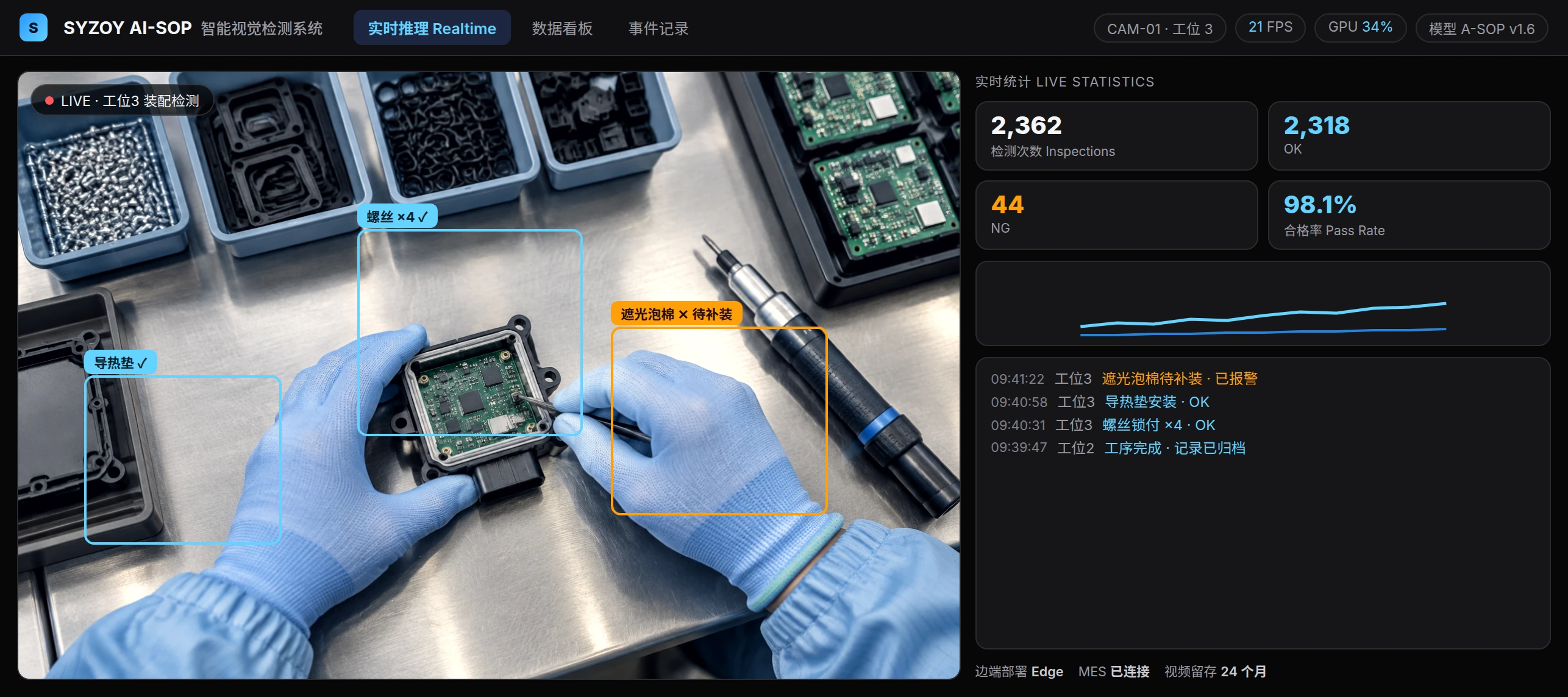
Standard operating procedures exist in every factory — but what actually happens on the shop floor is rarely visible until a defect escapes. AI-SOP digitizes that layer: industrial cameras watch the workstation, deep-learning models recognize each step and each part, and deviations — missing, wrong, out of sequence or timed out — trigger instant alarms and records instead of after-the-fact complaints.
Industrial cameras capture each workstation at critical points, providing raw material for behaviour recognition.
Video streams are pre-processed and enhanced to cut compute load and improve recognition accuracy.
Pretrained models with business fine-tuning recognize each operation and match it to the SOP.
Results are compared with the SOP template in real time — missing, out-of-sequence and timeout events detected.
Sound-light alarms, notifications and PLC interlocks fire; anomaly video and records are archived automatically.
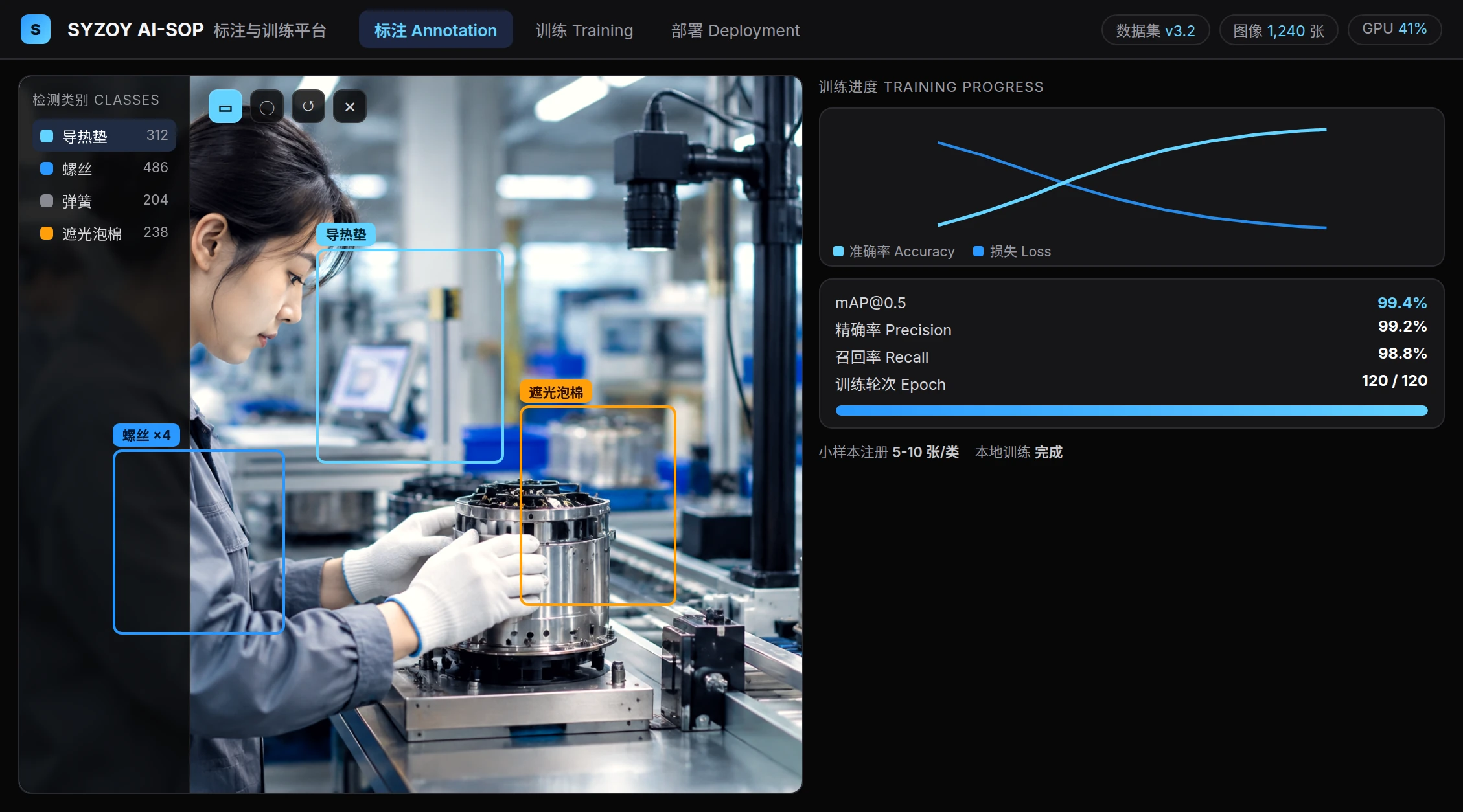
The AI-SOP platform bundles the full workflow: register or annotate on site, train locally, deploy to the edge and run in real time — no external platform, no data leaving the factory.
Single-stage architectures tuned for industrial scenes detect parts, tools and boxes in real time; cross-frame tracking removes ID flicker and missed detections on moving lines.
Skeleton extraction (OpenPose / MediaPipe) with temporal graph modelling (ST-GCN) recognizes operation sequences — and distinguishes "pick up" from "put down".
Fine-grained hand and finger action recognition verifies precise assembly operations that camera-level models would miss.
Register 5-10 images per class on site and run in under a minute — no thousand-image labelling campaigns, no dedicated training rig.
Edge appliances with dual GPU pipelines (small + large models) keep video and data on-premises.
Independent tracking IDs for every operator; dozens of stations and camera streams run concurrently.
| Scenario | Verified accuracy |
|---|---|
| Small-sample registration (most scenarios) | >99% |
| Automotive assembly — missing / wrong parts | ≥98% |
| Packaging lines | ≥99.5% |
| 3C electronics | ≥99.2% |
| Food & chemical | ≥99.5% |
| Behaviour recognition rate / over-kill rate | ≥95% / ≤1% |
Project-verified figures; accuracy varies with scene, material and lighting conditions.
Walk the workflow, identify risk points and agree the detection requirements.
Camera and lens selection (high-frame-rate line cameras, macro cameras), lighting and mounting design.
On-site registration or full annotation; dataset build and augmentation.
Training on local edge appliances or servers; small and large models optimized for the task.
Cameras, edge computing, IO triggers, alarm devices and MES/PLC interfaces installed and wired.
Accuracy validated on site, parameters tuned, documentation and training delivered.
* Example: a 100,000-parts/month assembly line moving from a 2% to a 0.5% defect rate — 1,500 fewer defects per month at ¥115 (material + rework) each: about ¥172,000 saved monthly, before counting brand and complaint costs avoided.
Assembly verification, missing-part checks, fastening and sequence confirmation.
SOP compliance, PPE checks and spray-operation standardization on coating lines.
Carton contents, tape, inserts and label verification at line speed.
Small-part registration and appearance checks in fast-changeover lines.
Pack integrity and assembly completeness in regulated environments.
Zone safety checks and material-stack deviation detection.
AI-SOP runs as a standalone station system or as the perception layer of a digital factory — combined with AI-MES, every inspection result is bound to production batches and process data.
Nearly 30 coating lines delivered. Let us help you plan, build or upgrade yours.
Scan with WeChat